From the Design Desk
A Hybrid Feedback Model for STEM Assessments
How Stemble’s design team is combining AI-generated feedback with TA-assigned grades to give students richer, more consistent feedback.
Ellie Arnold, PhD and

Providing detailed (and consistent) feedback takes time and training. In a large chemistry course, TAs may only have time to leave a few words on each response, giving students limited insight into where they went right or wrong. At Stemble, we’ve always worked toward clear, consistent feedback through well-defined rubrics. Our design team has been exploring another way to put that guidance into practice: a hybrid grading approach that combines AI-generated feedback with manually assigned grades.
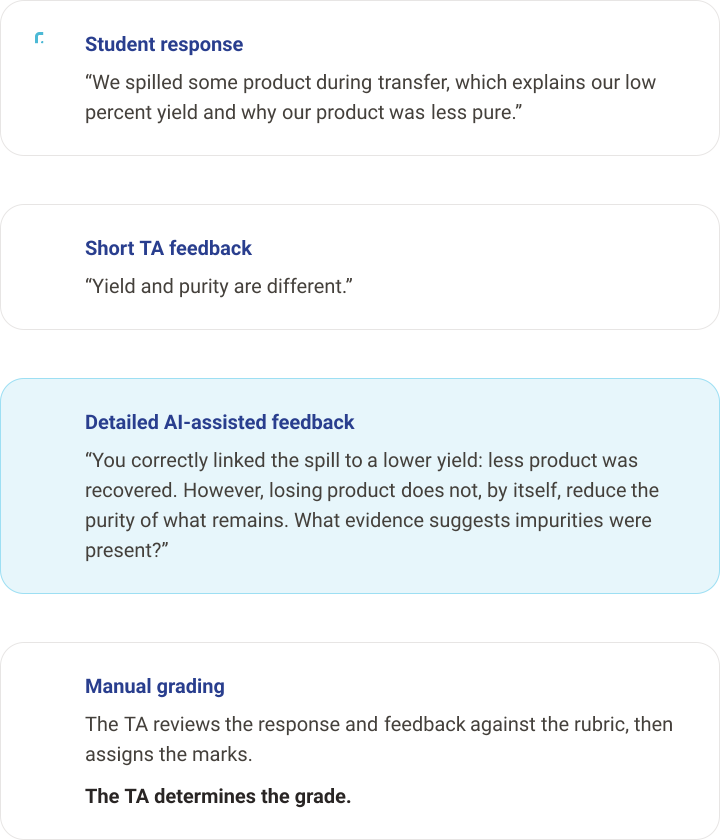
In this model, AI provides feedback on each individual question, guided by the assessment rubric. TAs can use that feedback as a second source of input as they review the student’s work, formulate their own comments, and assign marks. In this hybrid approach, the source of the final grade is the TA, not the AI.
The exciting part? Students can receive richer explanations of their work, and TAs have a more consistent starting point to support their review. The feedback can help students understand what they did well, where their reasoning needs attention, and how to improve.
A Small Example
Imagine a lab report asking students to explain how an experimental error affected their results. One student writes: “We spilled some product during transfer, which explains our low percent yield and why our product was less pure.”
With limited marking time, a TA might leave a brief comment such as “Yield and purity are different.” AI-generated feedback can help unpack that distinction:
“You’ve correctly identified that spilling product during transfer could reduce your percent yield because less product was recovered. However, losing some product does not, by itself, make the remaining material less pure. Purity describes the composition of your sample. What evidence from your experiment suggests that impurities were present?”
The TA reviews this feedback alongside the student’s report and the rubric. They can use the AI feedback to help formulate their own comments and assign the marks.
Another Option for Different Teaching Contexts
Comfort with AI varies across instructors, TAs, and students. For some courses, uncertainty about its role in grading can become a roadblock.
This hybrid approach gives those teams another way to use AI feedback within a workflow they’re comfortable with. Students know that a person determines their grade, while still benefiting from detailed feedback on individual responses. TAs retain responsibility for grading, with an additional source of guidance to support their decisions. The right balance will depend on the course, the teaching team, and their goals.
Hybrid grading adds another option alongside Stemble’s existing approaches, giving instructors flexibility in how they bring AI into their assessments. For Stemble, that flexibility serves the same ultimate goal: a better student experience, with clear, consistent feedback that helps students understand their mistakes, build confidence, and improve their learning outcomes.

Ellie Arnold, PhD
Marketing and Community Lead
Ellie brings a background in chemistry, education, and community-building to her role at Stemble. She holds a PhD in Chemistry and Biomedical Engineering from the University of Toronto and has spent much of her career working with researchers, students, and partners across academia and industry. At Stemble, she focuses on sharing the stories behind the platform, building connections with educators, and growing a community around better STEM teaching. When she's not at work, Ellie can usually be found outside with her two boys, her dog, and a healthy amount of chaos.

Tanya Irani, MSc
Instructional Designer
Based in Timmins, ON, Tanya holds a Master of Science in Biology. With over a decade of teaching experience, including several years in post-secondary education, she brings a strong understanding of how people learn. Her work focuses on creating engaging and accessible learning experiences that make complex ideas easier to understand and apply. She is especially interested in the intersection of learning science, technology, and instructional design, and how thoughtful design can improve the learner experience. Outside of work, Tanya enjoys running, baking, travelling, and spending time with her friends, family and her dog.